
GOP seeking to protect Trump’s agenda
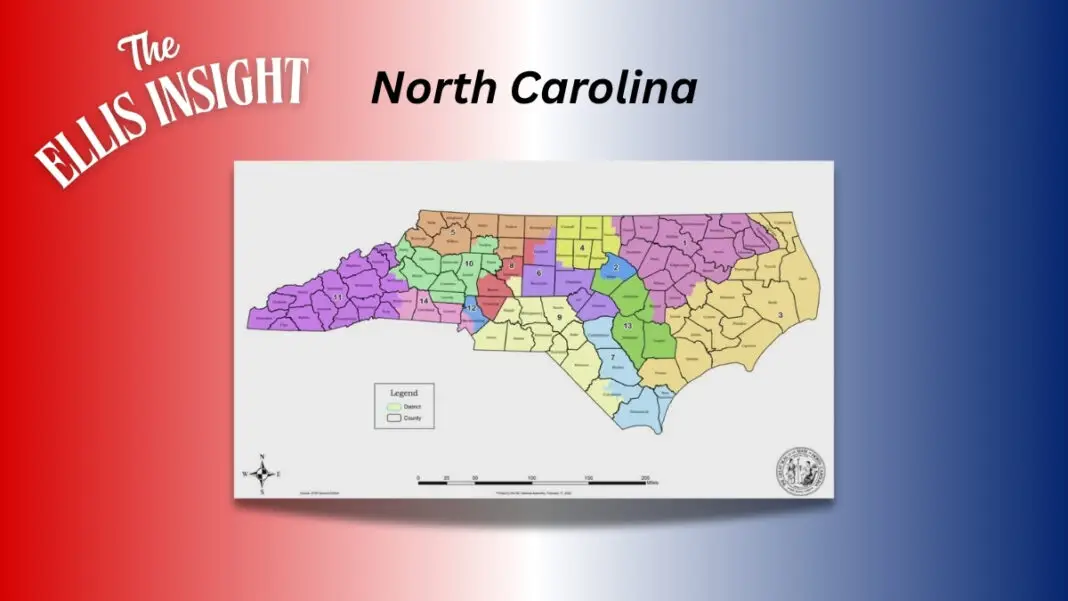
The Tar Heel State of North Carolina has joined the redistricting wars as members in both the state House of Representatives and state Senate voted this week to adopt a new congressional map.
Republican legislative leaders saying the need to protect President Trump’s agenda and counter what states like California are doing to help Democrats became the impetus for the North Carolina legislators’ action of revising their state’s federal district plan.
Since North Carolina law gives only the legislature the power to redistrict, Democratic Gov. Josh Stein had no role in the process. Therefore, upon passing each chamber – the House followed the Senate’s lead and voted favorably yesterday – the new map became law.
The 2025 congressional plan shifts ten counties between Reps. Don Davis’ (D-Snow Hill) 1st District and Greg Murphy’s (R-Greenville) 3rd CD. The shift makes the 1st District, which President Trump carried in 2024 before the electorate switched back to Rep. Davis, more Republican while the overwhelmingly Republican 3rd District becomes more Democratic.
The Republicans’ political mark is clearly Rep. Davis. In November, the incumbent was re-elected with only a slim 49.5 – 47.8 percent margin over Republican nominee Laurie Buckhout. With such a small Democratic congressional win in a district that President Trump carried, and bordering a solidly Republican district to the south, it made the 1st District an easy GOP target.
The 1st CD begins at the Virginia border and covers most of northeast North Carolina. To make it more Republican, the map drawers drove the district further south along the coast to annex additional GOP counties. This forced Rep. Murphy’s 3rd CD to move west and further inland. The remaining dozen Tar Heel congressional districts remain untouched.
The changing counties transform the 1st from one where President Trump defeated Kamala Harris 51-48%, into a seat where the electorate would have posted a 55-44% Republican margin. Conversely, the Trump percentage in District 3 would recede from 57.9 to 53.5. While Rep. Murphy’s district clearly becomes more competitive, he will still have enough of a partisan margin to win comfortably in a region that is likely to grow more Republican as the decade progresses.
Rep. Davis took to social media, according to the Down Ballot political blog reporters, to indicate that he would seriously consider remaining in the District 1 race even though his hometown of Snow Hill in Greene County would move to CD-3.
The Congressman said, “as we look at new congressional districts, I am considering every option, drawing on my local roots, experience in the military, and commitment to education,” in deciding what political move to make. Mr. Davis’ problem is there are no other available offices for which he can compete in 2026.
Though North Carolina has a dozen statewide offices, only one, US Senator Thom Tillis’ (R) open seat, is on the ballot next year. Since Democratic former Governor Roy Cooper is already in that race and a consensus candidate, Mr. Davis has virtually no other political option than to run for the US House in a more difficult district.
With Ms. Buckhout accepting a job in Washington with the Trump Administration, she will not return for a 2026 rematch. In the race are Rocky Mount Mayor and former congressional candidate Sandy Roberson and state Sen. Bobby Hanig (R-Currituck).
Lenoir County Commissioner Eric Rouse (R) recently announced his congressional candidacy, but Lenoir County moves to the 3rd District under the new redistricting plan. It is unclear whether Mr. Rouse will continue now that his home political base is no longer in the 1st District.
Redistricting is nothing new in North Carolina. In the previous decade, the maps kept changing almost every election cycle. The reason was the dispute between the Republican legislature and the Democratic state Supreme Court. The preponderance of members in each body held different redistricting legal opinions. When the Republicans captured the court majority in the 2022 election, a unified redistricting approach was adopted.
We can expect lawsuits to be filed over the new map, but the chances of overturning the plan clearly drawn for partisan and not racial reasons means the 2025 version will very likely be the footprint upon which the candidates will run next year.

If you value articles like this, sign up for our daily email newsletter and support us with a donation.

Related Articles
Political Roundup – Saturday, October 17, 2026
SENATE
Florida
Polls have been seesawing between appointed Sen. Ashley Moody...