

Bill O’Reilly stood before a packed audience at the Reagan Library last month, holding up his latest book and delivering a line that cut straight to the heart of America’s current struggles. “Evil is obviously on display in America, so really understanding it is imperative,” the veteran newsman told the crowd. Those words carried extra weight coming just days after his new book Confronting Evil: Assessing the Worst of the Worst claimed the number one spot on the New York Times bestseller list.
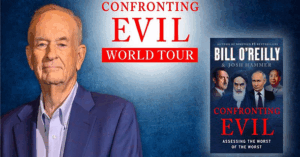
The achievement marks O’Reilly’s remarkable 20th New York Times number one bestseller, a milestone that places him among the most successful non-fiction authors in American publishing history. Written with conservative commentator Josh Hammer, the book examines history’s most destructive figures, from Genghis Khan and Joseph Stalin to Adolf Hitler and modern threats like Vladimir Putin and Mexican drug cartels.
For Catholic conservatives watching the moral fabric of American society strain under increasing pressure, O’Reilly’s latest work arrives at a crucial moment. The book’s success reflects a growing hunger among Americans to understand the nature of evil and how to confront it, both in historical context and in contemporary culture.
St. Martin’s Press, O’Reilly’s publisher, announced the book’s debut at the top of the Times nonfiction list, noting that it follows his previous bestseller Confronting the Presidents: No Spin Assessments from Washington to Biden, which launched his new “Confronting” series after the massive success of his “Killing” series of historical narratives.
“O’Reilly’s previous bestsellers, part of the ‘Killing’ series of narrative nonfiction, set the gold standard,” the publisher stated. “This new series adds to his position as the top nonfiction author in publishing today.”
The book’s rapid ascent to bestseller status, spending two weeks on Amazon’s top 10 list before claiming the Times crown, demonstrates more than just O’Reilly’s celebrity drawing power. Catholic teaching has always emphasized the importance of recognizing and confronting evil in all its forms, from personal sin to societal corruption. Saint Augustine wrote extensively about the necessity of moral discernment, while Saint Thomas Aquinas described just governance as a bulwark against tyranny and injustice.
O’Reilly’s examination of historical evil figures provides a framework that resonates deeply with Catholic understanding of moral clarity. The Church teaches that confronting evil requires both spiritual discernment and practical action in the temporal realm. Pope Saint Pius X emphasized that Catholic moral and natural law should inform public life, particularly when fundamental human dignity is at stake.
The timing of O’Reilly’s book success coincides with increasing concerns among Catholic conservatives about moral relativism’s influence on American culture and politics. The book’s focus on figures like Stalin and Hitler serves as a stark reminder of where societies can drift when they abandon objective moral standards rooted in natural law.
Radio host Mark Levin, himself a bestselling author, recently interviewed O’Reilly about the book, highlighting how historical patterns of evil often repeat when people fail to learn from the past. This educational aspect aligns with the Catholic tradition of using historical examples to teach moral lessons and guide contemporary decision-making.
O’Reilly’s media appearances promoting the book have reached millions of Americans across network television, cable news and radio platforms. His hit broadcast “No Spin News” has given him additional opportunities to discuss the book’s themes with his audience of over 18 million readers who have purchased his historical narratives.
The success of Confronting Evil also reflects a broader conservative movement to reclaim historical narrative from ideological distortion. Catholic conservatives have long argued that understanding evil in its proper context requires acknowledging objective moral truths rather than cultural relativism that obscures the distinction between good and evil.
For defenders of America’s Constitutional Democratic Republic, O’Reilly’s work provides valuable insights into how evil operates through political systems and social movements. The book’s examination of drug cartels, for instance, offers contemporary relevance as these criminal organizations continue to devastate communities along the southern border and throughout American cities.
The inclusion of Vladimir Putin among history’s evil figures takes on particular significance as Americans grapple with international threats to freedom and democracy. Catholic social teaching emphasizes that nations have obligations to protect innocent life and promote human dignity, principles that guide how faithful citizens should evaluate foreign policy challenges.
O’Reilly’s collaboration with Josh Hammer, a prominent conservative legal commentator, brings constitutional expertise to the historical analysis. This partnership reflects the important connection between understanding evil in historical context and protecting the legal and institutional frameworks that safeguard freedom.
The book’s commercial success demonstrates that Americans hunger for clear moral guidance in an era of increasing confusion about fundamental questions of right and wrong. Catholic conservatives have consistently argued that natural law provides the foundation for this moral clarity, offering objective standards that transcend cultural and political divisions.
As O’Reilly continues his promotional tour, his message about the importance of confronting evil resonates with audiences seeking both historical understanding and practical wisdom for contemporary challenges. The book serves as more than entertainment or education; it functions as a call to moral engagement in a culture that often seems reluctant to make definitive judgments about good and evil. Bill O’Reilly, a practicing Roman Catholic, understands this clearly.
The success of Confronting Evil suggests that Americans remain capable of recognizing moral truth when it’s presented clearly and compellingly. For Catholic conservatives committed to both faith and civic engagement, this represents an encouraging sign that the broader culture hasn’t completely abandoned the moral foundations necessary for a free and just society.