
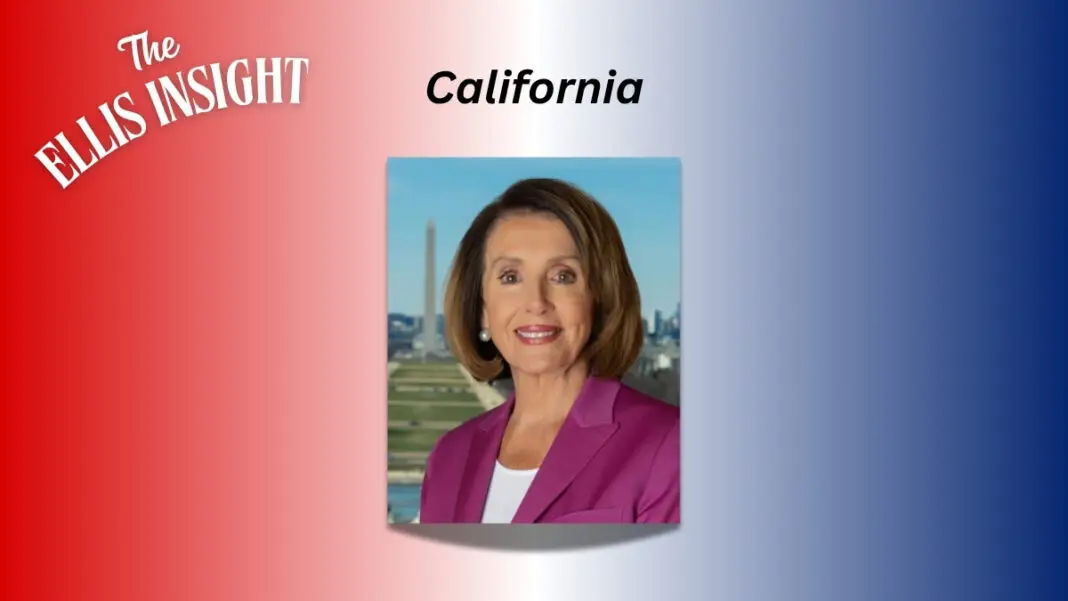


Scott Wiener considered heir apparent for her seat
In yesterday’s Update, a promise was made to analyze Maine US Rep. Jared Golden’s (D-Lewiston) retirement decision, but former House Speaker Nancy Pelosi announcing that she will retire when the current Congress ends has taken center stage. On Monday, the political situation that Rep. Golden leaves behind will be presented.
Nancy Pelosi was first elected to Congress back in 1987 when she won a special election to replace the late Rep. Sala Burton (D-San Francisco). Ms. Burton ran for and was elected to the seat in 1983 when her husband, then-Rep. Phil Burton (D) himself suddenly passed away.
Before coming to Congress, Ms. Pelosi had been the California Democratic Party chair. She grew up, however, in Baltimore where her father, Thomas D’Alesandro, was the city’s Mayor. Therefore, her introduction to elective politics came at a young age.
At the end of next year, Rep. Pelosi will have served 39 years in the House, and eight of those as Speaker. She became the first, and only, woman to hold the post when the Democrats regained the House majority in 2007 after a 12-year hiatus from power.
Rep. Pelosi would then take a step back to Minority Leader in 2011 when Democrats lost control of the House. She returned to the body’s top post in 2019 and held the Speakership until the Democrats again lost the majority in 2023. At that point, she retired from the House leadership but remained as a regular member through the present time.
This year, Rep. Pelosi’s political outlook back home became more challenging. While she’s had opponents in every election, none had been substantial, meaning she was able to record landslide wins every two years.
When Sakat Chakrabarti, who quarterbacked Alexandria Ocasio-Cortez’s (D-NY) upset win in 2018, announced his intention to challenge the former Speaker in the 2026 Democratic primary, most believed he was not a substantial threat to defeat Ms. Pelosi. His personal wealth and track record with AOC’s upset campaign, however, gave him a modicum of credibility that no other Pelosi opponent had commanded.
The political situation became even more intriguing last month when three-term state Senator Scott Wiener (D-San Francisco) announced that he would also enter the race, presumably to challenge Ms. Pelosi. The move was a surprise since it was assumed that Sen. Wiener, who represents even more of San Francisco than does Pelosi because California state Senate seats are bigger than congressional districts, would wait until she retired to run for Congress.
Some believed the Wiener move was a ploy to encourage the Congresswoman to retire. Most believed he would have backed off a challenge should she have decided to run again. Had Wiener moved forward, and with Chakrabarti also in the race with the goal of building himself a local political base, the campaign would have become significant.
A race against this pair, even though her chances of achieving victory were high, promised to be a difficult political run that would have taken a toll.
Because little issue disagreement is evidenced among Pelosi and her two opponents, much of the campaign would have concentrated on her age (86 at the time of the next election), and that San Francisco needed a new Representative who could build seniority for the long term.
Whether he was forcing the retirement issue or would have truly challenged her, the end result spun in Sen. Wiener’s favor, and he is now the heir apparent for the seat.
All things considered, the time appeared right for Ms. Pelosi to exit the political stage and begin her retirement after a very long career in the public eye.
Rep. Pelosi leaving the 11th District means there will be 38 open US House seats for the 2026 election to date, after the two special elections in Tennessee and Texas are filled. Like almost all other opens from both parties, CA-11, which changes little under the new California map, will be another safe seat for the incumbent party.
Considering that California employs the jungle primary system where the top two finishers advance to the general election irrespective of political party or percentage attained, we could easily see two Democrats advancing from the state’s June 2 open primary.