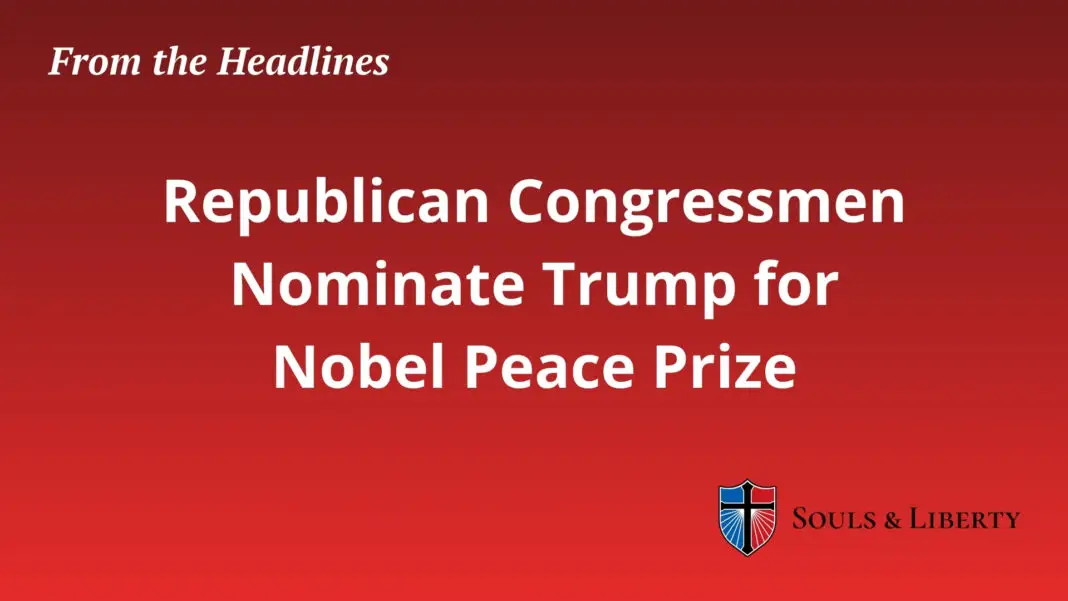


Representatives Andy Ogles of Tennessee and Marlin Stutzman of Indiana quietly submitted their letter to the Norwegian Nobel Committee in January, joining a growing chorus of voices recommending President Donald Trump for the world’s most prestigious peace prize.
Their nomination letter pulls no punches about why they believe Trump deserves recognition.
“We respectfully submit this nomination of President Donald J. Trump for the Nobel Peace Prize, in recognition of his concrete contributions to international fraternity, his leadership in reducing conflict and the risk of war, and his commitment to fostering dialogue as a path toward reconciliation,” the Congressmen wrote to the Nobel Committee.
The timing couldn’t be more significant. Trump has spent recent weeks shuttling between meetings with Russian President Vladimir Putin and Ukrainian President Volodymyr Zelensky, working to broker an end to the devastating conflict that has raged since Russia’s 2022 invasion. After meeting with Putin in Alaska on Friday, Trump floated the possibility of deploying U.S. peacekeeping forces to Ukraine during his Monday sit-down with Zelensky, though he later walked back the troop deployment idea during a Tuesday appearance on Fox & Friends.
Ogles and Stutzman point to a track record that extends far beyond the current Ukraine negotiations. Their letter specifically cites the Abraham Accords, which normalized relations between Israel and several Arab nations, and the Washington Agreement between Serbia and Kosovo. These diplomatic achievements, they argue, demonstrate Trump’s approach of “securing landmark diplomatic agreements” and “actively pursuing peaceful resolutions to some of the world’s most entrenched disputes.”
“Trump is not a warmonger — he’s a peacemaker,” Ogles declared on X Tuesday. “The world has fewer wars because of Donald Trump’s leadership.”
Stutzman echoed this sentiment in his statement to the Washington Examiner: “No President since Ronald Reagan has ever been more successful at creating peace on the international stage than President Trump. The world is safer with Donald Trump as commander in chief of our country. No one is more deserving of this year’s Nobel Prize.”
The congressional nomination adds to a remarkable list of supporters that includes Israeli Prime Minister Benjamin Netanyahu, who presented his own nomination letter to Trump during a White House meeting in July. “He is forging peace, as we speak, in one country, in one region after the other,” Netanyahu told the president as cameras rolled.
Perhaps most surprising was the conditional endorsement from former Secretary of State Hillary Clinton, Trump’s 2016 Democratic opponent. Speaking last week, Clinton offered her own potential nomination with specific terms: “If President Trump were the architect of that, I’d nominate him for a Nobel Peace Prize. Because my goal here is to not allow capitulation to Putin.”
Clinton’s qualified support highlights the complexity surrounding Trump’s peace efforts. Critics worry about potential concessions to authoritarian leaders, while supporters emphasize results over process. The Abraham Accords, for instance, achieved what many diplomatic experts considered impossible, creating new partnerships in the Middle East without forcing Israel to make territorial concessions.
Trump himself has never hidden his frustration about being passed over for the prize. Earlier this year, he expressed his skepticism about the committee’s intentions: “They will never give me a Nobel Peace Prize. It’s too bad. I deserve it, but they will never give it to me.”
White House press secretary Karoline Leavitt took a more diplomatic approach last month, telling reporters it was “well past time that President Trump was awarded the Nobel Peace Prize.” Her comments reflect a broader White House strategy to highlight Trump’s peace initiatives while building momentum for international recognition.
The Catholic perspective on Trump’s peace efforts aligns with centuries of Church teaching about the proper role of political authority in pursuing the common good. Catholic social doctrine, rooted in natural law principles, consistently emphasizes peace through justice and dialogue. As the Gospel of Matthew records Christ’s words: “Blessed are the peacemakers, for they will be called children of God.”
This Biblical foundation for peacemaking doesn’t require perfect leaders or perfect processes. Rather, it calls for concrete efforts toward reconciliation and the reduction of human suffering. The Abraham Accords brought former enemies to the negotiating table. The current Ukraine discussions, whatever their ultimate outcome, represent exactly the kind of diplomatic engagement Catholic teaching promotes over military solutions.
Pope St. Pius X’s encyclical Vehementer Nos reminds us that moral principles should inform political action, not remain confined to church pews. When political leaders pursue genuine peace, especially through dialogue rather than force, they participate in God’s work of reconciliation whether they recognize it or not.
The constitutional implications are equally significant. Article II grants the executive branch primary responsibility for foreign relations and diplomacy. Trump’s peace initiatives operate squarely within this constitutional framework, representing exactly the kind of executive leadership the founders envisioned for international affairs.
Conservative constitutional scholars have long argued that the strict separation of faith from public life represents a modern distortion of the founders’ intent. The pursuit of peace through principled diplomacy reflects natural law principles that informed the founding generation’s understanding of good government.
Representative Carter of Georgia, another Trump nominator, framed the issue in practical terms during recent House floor remarks: “When we see concrete results in reducing armed conflict and bringing former enemies together, we should recognize and encourage that leadership regardless of party politics.”
The Norwegian Nobel Committee faces a deadline that has already passed, having closed nominations in January. This year’s prize will be decided from among those nominees, including Trump’s multiple nominations from congressional allies, Netanyahu, and potentially others whose submissions haven’t been made public.
Whatever the committee ultimately decides, the nomination process itself has achieved something significant. It has focused international attention on diplomatic alternatives to endless conflict and highlighted specific achievements that might otherwise be overshadowed by political noise.
For Catholic Americans who believe faithful citizenship includes supporting leaders who pursue peace, Trump’s nominations represent more than political theater. They reflect a recognition that peacemaking, even imperfect peacemaking, deserves encouragement and recognition.
The world watches as Trump continues his Ukraine negotiations and other diplomatic initiatives. Whether or not a Nobel Prize follows, the effort to reduce human suffering through dialogue rather than warfare reflects principles that align with Catholic teaching — and transcend party politics.
President Trump, however, has indicated that his eyes are on a prize transcending even the Nobel Prize.
In an interview with Fox and Friends on Tuesday morning, Trump quipped that bringing an end to the war between Russia and Ukraine and saving thousands of lives could be “one of the reasons” he gets into Heaven.
After discussing how thousands of soldiers and civilians on both sides of the war are killed every week, Trump said, “I want to try and get to heaven if possible. I hear I’m not doing well. I hear I’m really at the bottom of the totem pole. But if I can get to Heaven, [saving lives] will be one of the reasons.”