
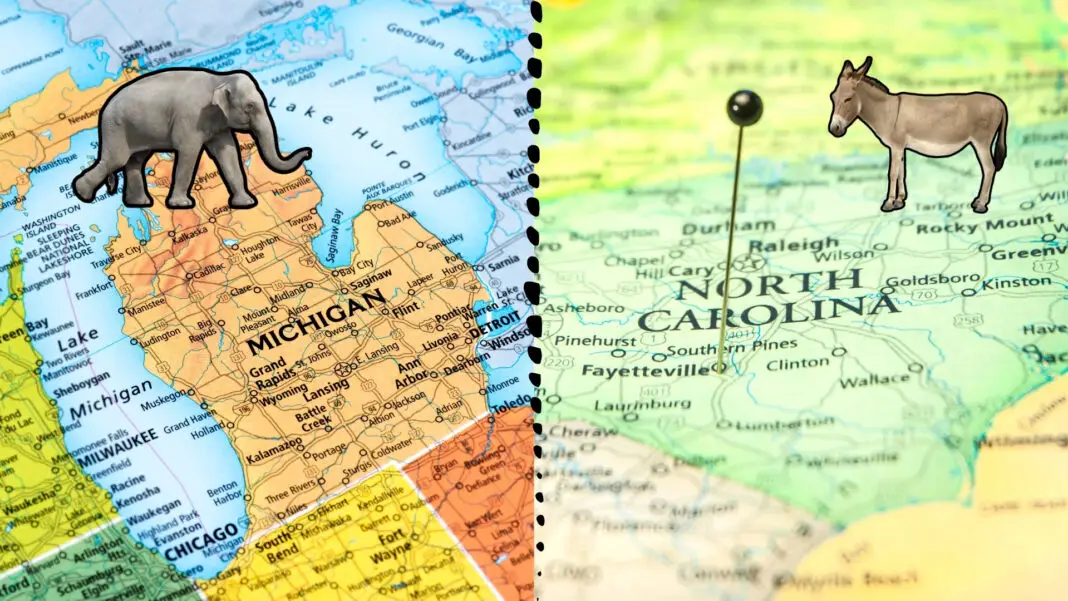
Chances for GOP rev up in Michigan and for Dems in North Carolina
Michigan
Michigan Republicans have caught a break.
US Rep. Bill Huizenga (R-Holland), who had been testing the waters for an open Senate bid, announced yesterday that he will not enter the statewide race and is likely to seek re-election in his 4th Congressional District.
Republican leaders had been striving to clear the Senate nomination field for former Representative and 2024 US Senate nominee Mike Rogers who came within 19,006 votes (three-tenths of one percentage point) of scoring an upset win last November, and now it appears their goal has been achieved.
In the 2024 race, Mr. Rogers proved a weaker early fundraiser and never reached resource parity with his Democratic opposition. While eventual winner Elissa Slotkin outspent Rogers $51 million to $12 million, outside organizations somewhat closed the deficit gap with $78 million coming into the state to aid Rogers while Slotkin supporters spent $65 million.
After the 2nd Quarter filing for the 2026 campaign, the three major Democratic candidates (US Rep. Haley Stevens, state Sen. Mallory McMorrow, and former Wayne County Health Director Abdul El-Sayed) recorded an aggregate $6.7 million in campaign receipts compared to Mr. Rogers’ $1.1 million.
Therefore, considering the continuing financial disparity among the Michigan Democrats and Republicans, Rep. Huizenga deciding not to pursue a challenge to Mr. Rogers for the party’s Senate nomination is an even greater help to the GOP team since they won’t have to issue major expenditures during the primary cycle.
Another advantage Rogers will have as a consensus candidate, in addition to being able to pool his lesser resources for just one campaign, is having until August 4, 2026, to draw largely unencumbered contrasts with the Democrats who will be battling among themselves for their own party nomination.
The unfolding candidate developments again underscore that the open Michigan Senate race will become one of the premier national Senate races next year.
North Carolina
North Carolina Democrats also have caught a break.
According to a report from Axios News, former Gov. Roy Cooper is communicating to North Carolina Democratic Party leaders that he will enter the state’s open Senate race and formally declare his intention as early as next week.
Mr. Cooper, who was elected four times as North Carolina’s Attorney General and then twice as Governor, was clearly the party’s first choice to run for the Senate and even more so after incumbent Sen. Thom Tillis (R) announced that he would not seek a third term.
The Senate move also suggests that Mr. Cooper will not launch a presidential campaign in 2027. This becomes particularly good news for Kentucky Gov. Andy Beshear (D), who is clearly moving along the presidential track and thus foregoing a bid for his own state’s open Senate seat. Several more governors, or recently replaced state chief executives, are also contemplating between running for Senate and President, and it is thought that most will enter the national race.
The real advantage to a potential Beshear presidential campaign is now having the clear opportunity of uniting the southern states in a fight for the party nomination, thus becoming a very strong regional candidate. This strategy would not have worked had Mr. Cooper joined the race also operating from a southern base.
Assuming the above presidential scenario works as depicted would also provide a boost to the Kentucky GOP. Mr. Beshear heading to the national campaign means the state’s open Senate race will now almost assuredly remain in GOP hands since the Governor was realistically the only Kentucky Democrat who could put the open Senate campaign into play.
Now the North Carolina focus turns to presidential daughter-in-law Lara Trump and Republican National Committee chairman Michael Whatley. Ms. Trump said during the week that she would decide whether to return to her home state to run for the Senate by Thanksgiving, but the Cooper decision to enter the Senate race earlier than expected, along with the state’s voter registration deadline, may shorten the GOP announcement timeline. Should Ms. Trump decide to run, she would have, like ex-Gov. Cooper on the Democratic side, a clear run for the party nomination.
Should she not run, which may be the more likely outcome, Chairman Whatley appears to be waiting in the wings, and chances are very high that he would quickly announce his own Senate candidacy.
North Carolina always features close races, and a 2026 US Senate race, even with ex-Gov. Cooper leading the Democratic ticket, will prove highly competitive.
While Mr. Cooper was an overwhelming favorite to win re-election as Governor in 2020, he ended with only 51% of the vote in clinching the second term. This means his average gubernatorial vote in his two elections was exactly 50%. In his three contested terms for Attorney General (2004, 2008, 2012), Mr. Cooper averaged a 56% support factor. In the 2016 election, Mr. Cooper ran unopposed for election to a fourth consecutive term.

If you value articles like this, sign up for our daily email newsletter and support us with a donation.

Related Articles
Political Roundup – Saturday, October 17, 2026
SENATE
Florida
Polls have been seesawing between appointed Sen. Ashley Moody...