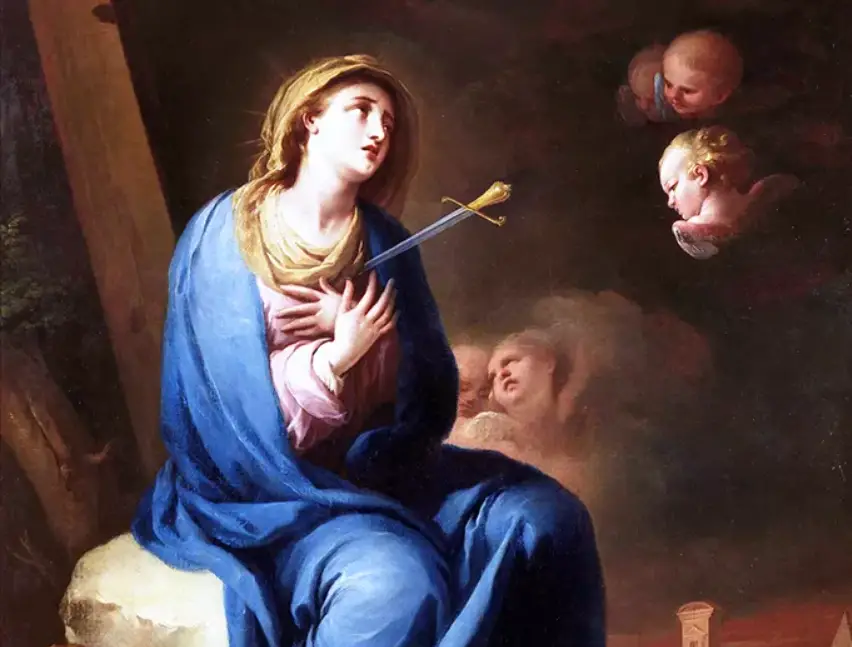

Devotion to Our Lady of Sorrows
If you value articles like this, sign up for our daily email newsletter and support us with a donation.

For some of us, navigating the often-painful physical and spiritual realities of daily life sometimes causes us to give up hope and live in fear.
Yet against this bleak backdrop is some good news: Many people are finding their way through such periods by turning to the Blessed Virgin Mary – by enlisting Her aid to align their lives with the perfect example of patient endurance, and ultimate victory – Her crucified Son.
Indeed, more people are turning to Her specifically under the title of Our Lady of Sorrows, seeking deliverance from diabolical affliction, as well as solace in the promises She made to those who remain devoted to Her.
Renowned theologian and exorcist Fr. Chad Ripperger named his order of exorcist-priests, the Society of the Most Sorrowful Mother (also known as the Doloran Fathers), for Our Lady of Sorrows.
"She promises to protect those who maintain a devotion to Her as Our Lady Sorrows, including their families, from diabolic incursion," Fr. Ripperger says.
"I realized that is what we're going to be dealing with a lot, and so it's important to actually have Her front and center in that battle and also because of the fact that obviously there is no demon that doesn't have absolute fear of Her. So we figured as long as She's on our side, we're good," he adds.
Father Ripperger says Our Lady of Sorrows also helps him in his holy profession as an exorcist.
"This is something I've discovered over the course of time, praying to Her and asking Her for intercession specifically in possession cases," he says. "But then later, I extended [asking for Her intercession] to quite a few other things."
"God reveals things to Our Lady that He does not reveal to other people – this is obvious just in Her apparitions," Fr. Ripperger notes. "The more intimate or the closer we are to people, the more likely we are to say things to them."
The priest says that he prays to Our Lady of Sorrows to help him when possession cases "kind of stall out just a little bit."
He explains that at times like this, he starts asking Our Lady of Sorrows "to please reveal to us where we go from here and then usually very quickly – all of a sudden – something would be revealed, or someone will receive a Grace, and then the case would start progressing again."
The priest reminds us that we can also pray to Our Lady of Sorrows for other people. "Parents can do it for their children," he notes, "or pastors can do it for their parishioners."
The revelations Our Lady gives us when we ask actually give us the information we need "to continue the progression of our spiritual life" and also "to engage in spiritual warfare," Fr. Ripperger explains.
NO FEAR
Father Ripperger says it's important to note that since Mary had "perfect confidence in God," She did not fear pain or suffering, and She did not panic. "Our Lady doesn't have fear. She's suffering each one of Her great sorrows."
"It's like 56 times or 57 times in the gospels where Jesus says 'Don't fear' … Our Lady would have lived that perfectly," he explains. "So there wasn't fear. It was just the sorrow."
HISTORY OF OUR LADY OF SORROWS
Devotion to Our Lady of Sorrows is not a new phenomenon. Indeed, it can be traced directly to Calvary and Christ's death on the Cross. Saint John, for example, writes, "Now there stood by the Cross of Jesus, His Mother …" (Jn. 19:25).
Meditations on the sufferings of the Mother of God appeared in the early Church and manifested more fully during Europe's medieval period. In the 13th and 14th centuries, religious orders like the Cistercians and the Servites of Mary promoted devotion to Our Lady of Sorrows. Through their preaching and missionary work, these orders spread the devotion throughout Europe and beyond its borders.
The impetus of the Servites' devotion occurred in 1233, when seven wealthy merchants in Italy experienced visions of the Virgin Mary on the Feast of the Assumption. The visions inspired them to leave their worldly lives behind and devote themselves to God and Our Lady.
In one of the visions, Our Lady provided them with their rule of life and habits. She also instructed them to spread devotion to Her Seven Sorrows, as this would benefit the spiritual life of everyone who heard and heeded the message.
In particular, the Servites promoted the Rosary, or chaplet, of the Seven Sorrows of Our Lady as a spiritual tool for deeper meditation that faithful continue to use to this day.

Mary also appeared to St. Bridget of Sweden (1303-1373) throughout the saint's life, and during these apparitions Our Lady taught Bridget the importance of meditating on the Seven Sorrows. Like the Servites before her, St. Bridget also promoted the chaplet of the Seven Sorrows as a powerful spiritual aid.
Our Lady revealed seven promises to St. Bridget for those who faithfully meditate upon the sufferings of Her life. People all over the world find comfort and strength in the promises to this day. As they have come down to us through the centuries, they are –
In the 1980s, Our Lady also appeared multiple times to three schoolgirls in the Central African nation of Rwanda, in the town of Kibeho. She identified Herself as the "Mother of God" and revealed the spiritual power and advantages of praying the Rosary of the Seven Sorrows regularly.
Our Lady promised, as She had to St. Bridget centuries before, that praying this Rosary would us help us understand why we sin, and that this knowledge, in turn, would give us the wisdom and strength to eliminate the weaknesses that keep us away from God and the happiness and peace He has intended for us.
A chapel named the "Shrine of Our Lady of Sorrows" was built in Kibeho in 1992 to honor the Blessed Mother's apparitions there. Referencing the region's history of strife, the local ordinary, speaking at the shrine's dedication, reflected:
Like May, September is considered a Marian month. It is devoted to the Seven Sorrows of Mary, and Sept. 15 is the Feast of Our Lady of Sorrows. As a result, September sees a surge in devotion to the Blessed Mother under this title. Devotees pray the Rosary of the Seven Sorrows and meditate on Our Lady's suffering, not as people who love suffering for its own sake, but as those who recognize, and embrace, the salvation that suffering bought.
This devotion to Mary is gaining momentum even as "diabolic incursions," as Fr. Ripperger puts it, intensify. The spiritual battle is indeed between the Mother of God and the Father of Lies.
The Blessed Virgin Mary suffered unspeakable pains throughout Her life. And as the mother of the Suffering Servant (Isaiah 53), She stood at the bottom of the Cross, witnessing her Son's Passion and Death.
This is why, as we face our own pains and temptations, we must turn to Our Lady and meditate on Her Seven Dolors, or Sorrows.
In a deeply mysterious way, the safest place to be, in these perilous times so inundated with demons, is at the foot of the Cross with Mary. There, alongside Her, we can lament Christ's suffering, renew our hope of spiritual salvation, and relish His ultimate triumph over sin and death. It is there that we are eternally protected and nourished by a most holy communion.
Editor's note: For an excellent selection of spiritual reading to aid in your prayer and meditation on this topic, click on the images below.


Dr. Barbara Toth has a doctorate in rhetoric and composition from Bowling Green State University. She has taught at universities in the US, China and Saudi Arabia. Her work in setting up a writing center at Princess Nourah bint Abdulrahmen University, an all-women's university in Riyadh, has been cited in American journals. Toth has published academic and non-academic articles and poems internationally.
Please join us in praying and fighting for Souls and Liberty; as well as, consider making a donation to support our work.