
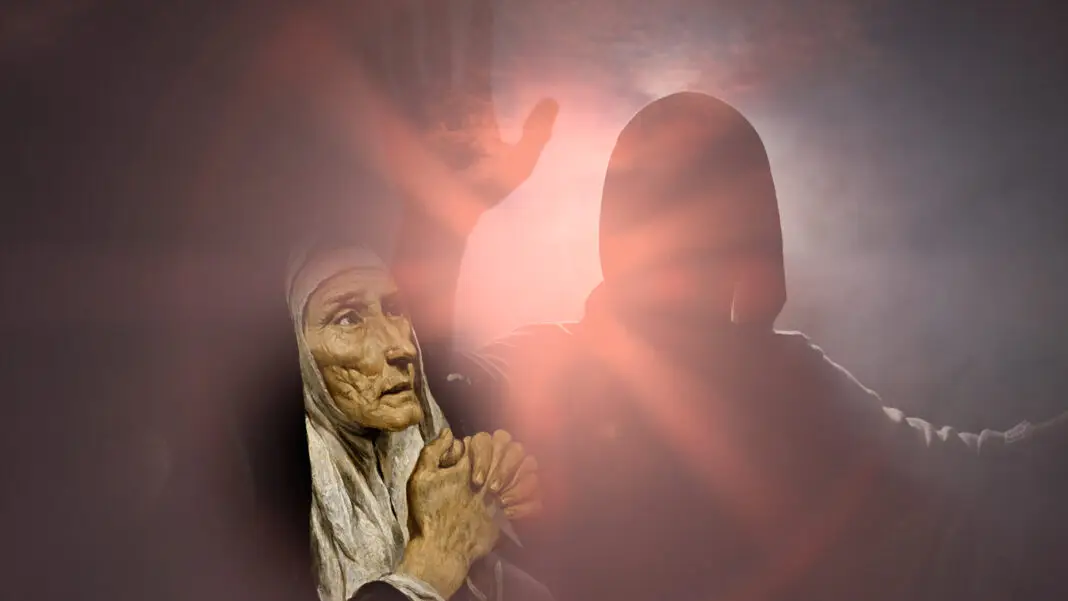


Saint Monica's decades-long cries to Heaven
If you value articles like this, sign up for our daily email newsletter and support us with a donation.

If someone tells you, "prayer makes all the difference," believe them. Indeed, that's the message of St. Monica's life and legacy – and of the prayer-inspired conversion her famous, and once profligate son, St. Augustine.
Many of us may want to give up on prayer when we get discouraged (easy in these perilous days) or when we don't get the answer we want, when we want it.
The devil is right there whispering in our ear – tempting us to give up the ship and abandon the barque of Peter.
Even if we have managed to hold tight to the faith, we all know others – friends, family members, maybe children or grandchildren – who succumb to despair and faithless lifestyles.

SAINT MONICA TO THE RESCUE
This is when St. Monica, a 4th century wife and mother, comes to the rescue and provides us with a model of action.
Monica (331-387) was born into a Christian family in a town near the Mediterranean coast of what is present-day Algeria. The area was part of the Roman Empire, and like many Christian young women of that time and place, Monica married a Roman pagan, who is said to have had an explosive temper and unfaithful ways.
Monica's faith was a source of conflict for her husband, who nonetheless eventually converted to Christianity, a testament to his wife's long-standing patience and perseverance in prayer.
Monica's way of negotiating conflicts with her husband is said to have served as an example for her female neighbors who came to her for advice about their own troubled marriages. She emphasized the same qualities she embodied: spiritual determination and patience, and the understanding that it was God, above all, who granted the prayers in His time.
The couple had three children, but it was their eldest, the prodigal Augustine, for whom Monica's persistent prayer has become famous for almost seventeen centuries.
From Augustine's early years, Monica cried to Heaven for the soul of her son. Popular early Christian legends maintained she wept every night for her son. At around age 11, he went to a school near his hometown that taught Latin, and pagan ideas and practices. As a teenager, he ventured farther from home to study in Carthage, a world- famous and worldly trading center in the Mediterranean region at the time.
There, by Augustine's own accounts, he fell into a life where "all around me hissed a cauldron of illicit loves." He called his sexual adventures a "hell of lust" and his life "foul and immoral."
It was in Carthage, too, that Augustine became a follower of Manichaeism, a dualistic religion founded in Persia in the previous century. Visiting his mother, he defended Manichaean propositions that deeply upset her.
During this time, Monica – worried about the direction of Augustine's life – sought the counsel of a bishop whom she tearfully begged to speak with her wayward son. "Go away now; but hold onto this: it is inconceivable that he should perish, a son of tears like yours," he told her.
In his writing, Augustine recalled that his mother had often referred to the bishop's words, saying she had taken them to be a message from Heaven.
Augustine moved to Rome to teach rhetoric and continue his hedonistic lifestyle; Monica followed. Then he moved to Milan to outpace his mother – some accounts say – but she found him there, as well.
It was in Milan that Augustine providentially met St. Ambrose, the bishop there, and where Monica's prayers were finally answered. Under Ambrose's mentorship, Augustine underwent a profound spiritual transformation.
About his conversion under Ambrose, Augustine wrote, "And I began to love him, of course, not at the first as a teacher of the truth, for I had entirely despaired of finding that in [God's] Church – but as a friendly man."
Augustine added, "Ambrose received me as a father would, and welcomed my coming as a good bishop should."
In Milan, after years of prayer and travail, Monica was able to witness her wayward son join the Church – baptized by St. Ambrose on Easter in 387.
Monica died en route to her hometown, having completed the work of doing all she could to help save her son's soul. Before she died, she uttered words that have come down through the centuries, often appearing on memorial cards: "All I ask is that you remember me at the altar of God."
Monica's tears and unceasing prayers were pivotal in guiding her son's spiritual journey; but also pivotal in guiding all those influenced by Augustine's preaching and writing through the centuries.
Saint Augustine is one of the Church's greatest theologians and is often considered the most significant Christian thinker, after St. Paul. His writings, including Confessions and The City of God, continue to inspire Christians and explain Christianity to our increasingly neo-pagan world.
Saint Paul preached the indispensability of prayer. He encouraged "praying at all times in the Spirit" and to be "constant in prayer." He advised "not to be anxious about anything" but to "let your requests be made known to God." He said we should make "supplications, prayers, intercessions, and thanksgivings … for all people." He told us to "pray without ceasing, give thanks in all circumstances; for this is the will of God in Christ Jesus for you."
Saint Monica heeded Paul's counsel and models for us the difference prayer can – and does – make in our lives. What better example to follow than hers as we seek to save our own souls and those of our loved ones?
Saint Monica's feast day is Aug. 27 – fittingly the day before the feast day of her son, St. Augustine.
Editor's note: Read a short biography of an illustrious saint, and find the moving and inspiring story of a mother so dedicated to her Faith and to her son that she spent her life in tears for both. Those tears were not in vain, and they produced bountiful fruit in due season.
Click here or on the image below.

Dr. Barbara Toth has a doctorate in rhetoric and composition from Bowling Green State University. She has taught at universities in the US, China and Saudi Arabia. Her work in setting up a writing center at Princess Nourah bint Abdulrahmen University, an all-women's university in Riyadh, has been cited in American journals. Toth has published academic and non-academic articles and poems internationally.
Kamala Harris represents the most extreme left wing of a Democrat party already captured by anti-Christian, Marxist elements. Throughout the run-up to the election, Souls and Liberty will be sounding the alarm against her candidacy and arming you with the information you need to take action in the public square to stop the takeover of our republic, and even Western Civilization.
Please join us in praying and fighting for Souls and Liberty; as well as, consider making a donation to support our work.